
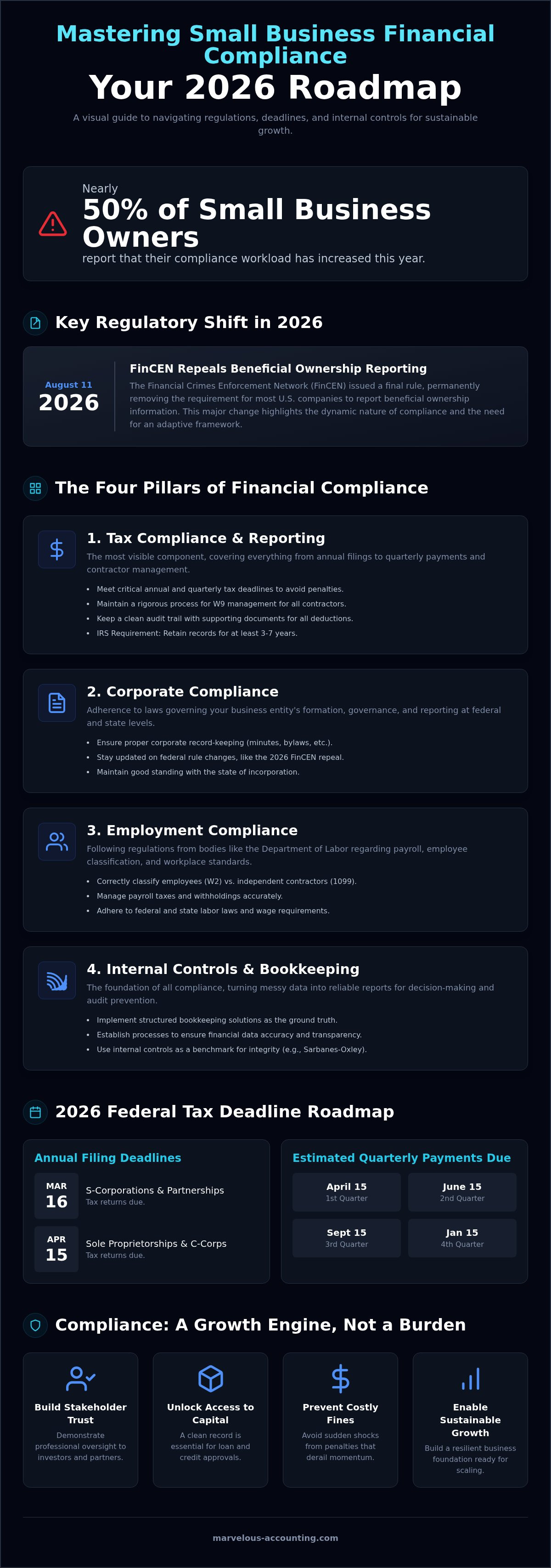
Nearly 50 percent of small business owners report that their compliance workload has increased this year. It's a staggering figure that reflects the growing pressure to maintain a clean, audit-proof financial system while trying to scale operations. You likely feel the weight of these administrative burdens, especially with the constant shift in federal regulations and tax obligations. Managing small business financial compliance shouldn't be a source of constant anxiety or a barrier to your growth.
This guide provides the structured framework you need to master 2026 requirements with precision. You'll learn how to navigate the recent repeal of the Corporate Transparency Act's reporting rules and meet critical tax deadlines, such as the March 16th date for S-Corporations and Partnerships. We'll outline a clear checklist of obligations to help you transition from messy records to a disciplined, organized system. By the end of this article, you'll have a roadmap for professional oversight that ensures your fiscal health remains secure and your business stays ready for any audit.
Key Takeaways
- Identify the four essential pillars of small business financial compliance to protect your firm from federal fines and systemic risk.
- Discover why structured bookkeeping solutions act as the ground truth for all regulatory adherence and audit prevention.
- Navigate the 2026 landscape with confidence by understanding recent shifts in federal reporting requirements and tax deadlines.
- Implement a structured roadmap designed to organize your financial records and ensure all quarterly obligations are met.
- Establish internal controls that transform messy financial data into reliable reports for informed decision making.
What is Small Business Financial Compliance in 2026?
Compliance in 2026 means more than just filing taxes on time. It is the active adherence to federal, state, and industry-specific financial laws that govern how your company operates. For many owners, small business financial compliance feels like a moving target. This perception is fueled by major shifts, such as the Financial Crimes Enforcement Network (FinCEN) issuing a final rule on August 11, 2026, which permanently removed beneficial ownership reporting requirements for U.S. companies. Such changes highlight why a dynamic compliance framework is a business asset rather than a burden.
Ignoring these obligations carries a heavy price. Non-compliance often results in severe financial penalties, legal action, and a tarnished reputation that can take years to rebuild. In 2026, the shift toward digital-first, transparent reporting means regulatory bodies have more visibility into your records than ever before. Real-time data sharing and automated flagging systems make it nearly impossible to hide messy books or unintentional errors. Establishing a disciplined system early prevents these risks from materializing.
The Scope of Federal Financial Regulations
The Internal Revenue Service (IRS) maintains strict standards for record-keeping, requiring businesses to keep supporting documents for at least three to seven years depending on the transaction type. The Department of the Treasury plays a central role in 2026 by overseeing the modernization of digital reporting systems to ensure accuracy across all filing platforms. While many regulations target larger entities, the Sarbanes-Oxley Act remains a critical benchmark for financial integrity and internal controls that ambitious small firms often adopt to prepare for future scaling or public offerings. The Small Business Regulatory Enforcement Fairness Act (SBREFA) ensures that federal agencies consider the economic impact of their regulations on small firms and provide accessible compliance assistance.
Why Compliance Matters for Scaling Businesses
A disciplined approach to compliance builds immediate trust with stakeholders and investors. When your financial reporting is transparent and accurate, you demonstrate a level of professional oversight that makes your firm a lower risk for lenders. This clarity facilitates easier access to business capital; most financial institutions now require a clean compliance record before approving significant loans or lines of credit.
Ultimately, legal conformity is directly linked to sustainable growth. It prevents the sudden shocks of audits or fines that can derail a company's momentum. By treating small business financial compliance as a foundational element of your operations, you ensure your business remains resilient. A clean financial history doesn't just keep you out of trouble; it positions you as a reliable partner in the national marketplace.
The Four Essential Pillars of Regulatory Adherence
Achieving comprehensive small business financial compliance requires a disciplined approach across four distinct areas: Tax, Corporate, Employment, and Internal Controls. These pillars aren't isolated silos; they form an interdependent system. Neglecting even one area creates a systemic risk that can compromise your legal protections and financial health. Federal bodies like the IRS, the Department of Labor, and the Department of the Treasury enforce these standards with increasing precision. Obligations related to the "Tax on Firm" are central to this structure, as they directly impact your entity's standing with federal authorities. You must maintain a steady hand across all four to ensure your business remains audit-proof and ready for growth.
Tax Compliance and Reporting Obligations
Tax obligations are the most visible component of your compliance structure. It's vital to distinguish between annual income tax preparation and the requirement for estimated quarterly payments. For the 2026 tax year, S-Corporations and Partnerships must file by March 16, while Sole Proprietorships and C-Corporations face an April 15 deadline. Estimated payments are due on April 15, June 15, September 15, and January 15. Missing these milestones triggers unnecessary penalties that drain your capital. You also need a rigorous process for W9 management to ensure contractor payments are documented correctly. Referencing the IRS Small Entity Compliance Guides can help you stay aligned with these federal expectations. A clean audit trail for every business deduction is your best defense during a review.
Corporate Transparency and Internal Controls
The landscape for corporate transparency changed on August 11, 2026, when FinCEN issued a final rule repealing beneficial ownership reporting for U.S. companies. While this reduces your administrative workload, maintaining small business financial compliance still demands strong internal controls. These checks and balances prevent financial mismanagement and internal fraud. You should implement clear protocols for account reconciliation and the separation of financial duties. Accurate financial reporting isn't just for the IRS; it's essential for maintaining your corporate status and protecting your personal assets from business liabilities. If your current records are disorganized, implementing structured bookkeeping solutions can provide the clarity you need to manage these complex systems effectively.
How Structured Bookkeeping Solutions Mitigate Audit Risks
Bookkeeping isn't just a back-office chore; it's the "ground truth" of all small business financial compliance efforts. Every tax return, financial statement, and loan application relies on the integrity of your ledger. When your books are disorganized, they become the primary trigger for IRS inquiries. Inconsistencies in reported income or unusual expense ratios often stem from poor record-keeping. Regulators view messy books as a red flag for deeper systemic issues. Professional bookkeeping solutions replace chaos with a disciplined framework that ensures your data is accurate and defensible.
Real-time financial reporting serves as an early warning system for your business. It allows you to detect anomalies and potential compliance gaps before they escalate into legal problems. Instead of looking at your finances once a year, you gain a clear view of your fiscal health every month. This proactive oversight moves your firm from a reactive stance to one of quiet confidence. You don't have to fear an audit when your records are built on a foundation of professional precision.
The Danger of DIY Financial Record-Keeping
Many owners rely on free or low-cost software that promises to automate everything. These tools often fail at nuanced categorization, leading to significant errors. For example, a loan repayment might be incorrectly recorded as a business expense, or personal draws might be labeled as deductible costs. These mistakes lead to tax penalties and interest that far outweigh the cost of professional help. Cleaning up a year of "messy books" during the high-stress tax season is always more expensive and less effective than consistent monthly maintenance. The return on investment for professional oversight far exceeds the perceived savings of free software by preventing costly tax penalties and ensuring every deduction is legally sound.
Building an Audit-Proof Financial Trail
Digital document retention is the non-negotiable standard for 2026. You must maintain high-resolution digital copies of every receipt, invoice, and contract. A structured framework ensures that every single transaction in your ledger is linked to a verifiable business purpose. This level of organization makes your financial trail transparent and easy for an auditor to follow. Beyond the legal requirements, there is a profound psychological benefit to this level of order. You gain the peace of mind that comes from knowing your records are professional-grade. This confidence allows you to focus on scaling your business rather than stressing over administrative burdens.
A Step-by-Step Compliance Roadmap for 2026
Transitioning from startup chaos to corporate order requires a structured approach. You can't achieve small business financial compliance through sporadic effort or year-end scrambles. It demands a sequential plan that integrates your daily operations with federal requirements. This roadmap moves you away from reactive stress and toward a disciplined system of professional oversight. By establishing a firm infrastructure and maintaining rigorous reporting, you protect your business from systemic risks and position it for national growth.
Phase 1: Establishing the Financial Infrastructure
The first step is the absolute separation of personal and business accounts. Mixing these funds creates a significant legal risk known as "piercing the corporate veil," which can expose your personal assets to business liabilities. Once your accounts are separate, you must select professional bookkeeping solutions that can scale with your firm's volume. A standardized chart of accounts is the next priority. This organizational structure ensures every transaction is categorized correctly from day one, providing the clarity needed for accurate financial reporting and future audits.
Phase 2: Ongoing Maintenance and Reporting
Consistency is the core of regulatory adherence. Monthly reconciliation is a non-negotiable task that confirms your internal records match your bank statements. This process allows you to identify errors or unauthorized transactions immediately rather than discovering them months later. You should also review your monthly financial reports to spot anomalies before they become legal issues or tax liabilities. Proactive documentation throughout the year is essential for a smooth 2026 tax season. Keep digital copies of all supporting documents to ensure every deduction on your return is defensible and audit-proof.
Your 2026 compliance calendar should include these critical milestones:
- March 16, 2026: Filing deadline for S-Corporations and Partnerships (Form 1120-S and Form 1065).
- April 15, 2026: Filing deadline for Sole Proprietorships and C-Corporations (Form 1040 Schedule C and Form 1120).
- Quarterly Deadlines: Estimated tax payments due April 15, June 15, September 15, and January 15, 2027.
- Monthly: Complete bank reconciliations and review financial reports by the 15th of each following month.
Effective small business financial compliance is not a seasonal event. It requires year-round professional tax preparation services to navigate changing laws and maximize your fiscal health. A steady hand in these areas ensures your business remains a reliable entity in the eyes of federal regulators and financial institutions alike.
Marvelous Accounting, LLC: Your Partner in Fiscal Integrity
Marvelous Accounting, LLC acts as a disciplined guide for firms navigating the complexities of small business financial compliance. We serve as the steady hand that brings order to your financial systems, allowing you to focus on scaling your operations. Our structured accounting frameworks are designed to meet the rigorous standards of 2026 federal regulations. By prioritizing accuracy and professional oversight, we eliminate the persistent fear of unintentional non-compliance. Our national service coverage ensures that regardless of where your business is based in the U.S., you receive consistent, high-level care. You don't have to carry the weight of administrative burdens alone when you have a partner dedicated to your fiscal integrity.
We don't just record transactions; we build the systems that support long-term growth. This methodical approach mirrors the organized nature of the services we offer. Our goal is to provide a composed and capable presence that alleviates the stress of regulatory adherence. Every sentence in your financial story should reflect precision and reliability. Marvelous Accounting, LLC provides the professional oversight that prevents audit stress and keeps your business moving forward with momentum.
Expert Tax Preparation and Bookkeeping Solutions
Managing the unique tax obligations of an LLC requires more than just filling out forms. Our firm specializes in comprehensive Tax Preparation Services that ensure every deduction is defensible and every deadline is met. We integrate these services with our Bookkeeping Solutions to provide a seamless flow of data. This approach generates high-level Financial Reporting that serves as a vital tool for informed decision-making. Our reports offer more than just numbers; they provide a clear roadmap of your company's performance. As a national firm, Marvelous Accounting, LLC maintains a professional register that matches the practical needs of businesses operating across the United States. We provide the expertise needed to navigate federal shifts without missing a beat.
Next Steps: Securing Your Business’s Future
The transition from disorganized records to a clear report of fiscal health starts with a single step. We invite you to offload your administrative complexities to our team of specialists. Marvelous Accounting, LLC provides the professional oversight necessary to ensure your business remains a reliable entity. A thorough compliance review can identify existing gaps and establish the internal controls mentioned earlier in this guide. This proactive strategy secures your business's future and provides the peace of mind you need to lead with confidence. Take the first step toward a cleaner, more organized financial system today. Ensure your business remains compliant with Marvelous Accounting, LLC.
Our process is methodical and efficient. We move quickly from identifying your current needs to implementing a path forward. There is no wasted space in our workflows. Every action we take is designed to reinforce your position as a compliant and professional business owner. Let Marvelous Accounting, LLC bring order to your complex systems so you can focus on what you do best.
Mastering Your Fiscal Future in 2026
Maintaining small business financial compliance requires a shift from reactive habits to a disciplined, year-round framework. We've explored how structured bookkeeping serves as the ground truth for your business, ensuring every transaction is defensible against IRS scrutiny. By adhering to the four pillars of regulatory adherence and following a sequential roadmap, you protect your personal assets and position your firm for national growth. Order isn't just about avoiding penalties; it's about building a foundation of transparency that stakeholders and lenders trust.
The complexities of 2026 regulations don't have to stall your momentum. Marvelous Accounting, LLC provides the professional oversight needed to navigate these systems with quiet confidence. Whether you require expert Tax Preparation Services, Bookkeeping Solutions, or Financial Reporting, our team acts as your steady hand in a shifting landscape. Don't wait for an audit to discover gaps in your records.
Get a Professional Compliance Review from Marvelous Accounting, LLC and transition from administrative stress to total fiscal clarity. Your business's long-term health depends on the precision you implement today.
Frequently Asked Questions
What are the most common financial compliance mistakes for small businesses?
Commingling personal and business funds is the most frequent error, which risks piercing the corporate veil and exposing personal assets. Missing federal tax deadlines, such as the March 16th date for S-Corporations, also leads to costly penalties. Failing to maintain digital receipts for a minimum of three years often leaves owners defenseless during an audit. Structured small business financial compliance frameworks help prevent these oversights by establishing clear protocols for every transaction.
How does structured bookkeeping help during an IRS audit?
Professional bookkeeping solutions provide a clear, defensible audit trail that links every ledger entry to its supporting documentation. When your records are organized, an auditor can easily verify the business purpose of each deduction, which significantly reduces the time and stress of the inquiry. Professional oversight ensures that your financial records are consistent and accurate, preventing the red flags that typically trigger deeper federal investigations into your company's fiscal health.
What is the Corporate Transparency Act and does it apply to my LLC in 2026?
On August 11, 2026, FinCEN issued a final rule that permanently removed the requirement for U.S. companies to report beneficial ownership information. This means the Corporate Transparency Act's reporting mandate no longer applies to your LLC. FinCEN is also deleting previously submitted information from its database. While this reduces your administrative workload, you must still maintain disciplined internal controls and accurate financial reporting to meet other federal standards and protect your corporate status.
How often should a small business review its financial reports for compliance?
You should review your financial reports at least once a month to ensure ongoing small business financial compliance. Regular monthly reviews allow you to spot anomalies, such as unexpected expenses or reconciliation errors, before they escalate into significant legal or tax liabilities. This frequency ensures your records remain accurate for quarterly estimated tax payments due on April 15, June 15, September 15, and January 15. Consistent oversight prevents the stress of year-end corrections.
Can I use free tax software for my business financial compliance?
Free tax software often lacks the sophisticated categorization needed for complex business entities. These tools frequently mislabel transactions, leading to incorrect deductions that can trigger audits or result in underpayment penalties. Relying on automated software without professional oversight creates a high risk of systemic error. Professional tax preparation services provide the precision and expert analysis required to navigate changing federal laws that generic, free platforms simply cannot offer.
What is the difference between tax preparation and financial compliance?
Tax preparation is the specific process of filing annual returns and paying obligations to the IRS. Financial compliance is a broader framework that includes tax preparation along with corporate transparency, internal controls, and employment law adherence. While tax filing is a seasonal event, compliance is a year-round discipline that ensures your entire financial system remains legal and audit-proof. Professional financial reporting bridges these two areas by providing a continuous view of your regulatory status.
Why is professional financial reporting essential for scaling businesses?
Professional financial reporting provides the transparency that lenders and investors require before committing capital to a growing firm. As you scale, your financial systems become more complex, making it harder to track fiscal health without a structured framework. Accurate reports demonstrate that your business is managed with professional oversight and a steady hand. This level of organization reduces the perceived risk for external stakeholders and facilitates smoother access to business loans.
How do I know if my business needs a professional bookkeeping solution?
You likely need a professional solution if you spend more time managing receipts than growing your operations or if your books are consistently behind. Signs of trouble include unreconciled bank statements, difficulty tracking deductible expenses, or anxiety regarding upcoming tax deadlines. If your current system feels like a burden rather than a tool for clarity, implementing structured bookkeeping solutions will provide the organized expert support needed to secure your firm's fiscal future.