
What if the accounting software you bought to save time is actually the primary source of your administrative stress? It's frustrating to spend hours on bank reconciliations only to realize your reports still don't offer a clear path forward. When weighing bookkeeping services vs software for your 2026 strategy, you must decide if you need a digital ledger or a professional partner. While 98% of accounting professionals now use AI, technology alone cannot replace the structured oversight required to prevent IRS audit triggers.
You want to stop worrying about tax compliance and start making decisions based on accurate, actionable data. This article clarifies the critical differences between automated tools and professional Bookkeeping Solutions so you can choose the most cost-effective path for growth. We'll analyze current market trends, including the 40% bonus depreciation phase-out, and show you how to reduce your administrative burden. By the end, you'll know exactly how to gain the financial reporting necessary to lead your business with confidence.
Key Takeaways
- Distinguish between simple data recording and the strategic interpretation offered by professional Bookkeeping Solutions.
- Assess the hidden financial drain of DIY software, such as misclassified entries and the sacrifice of your own executive time.
- Identify the specific revenue milestones and transaction volumes that make the choice between bookkeeping services vs software clear.
- Ensure total tax compliance and reduce audit risks by implementing structured accounting frameworks.
- Utilize comprehensive financial reporting to convert raw data into actionable insights for informed business decisions.
The Evolution of Financial Management: Software vs. Managed Solutions
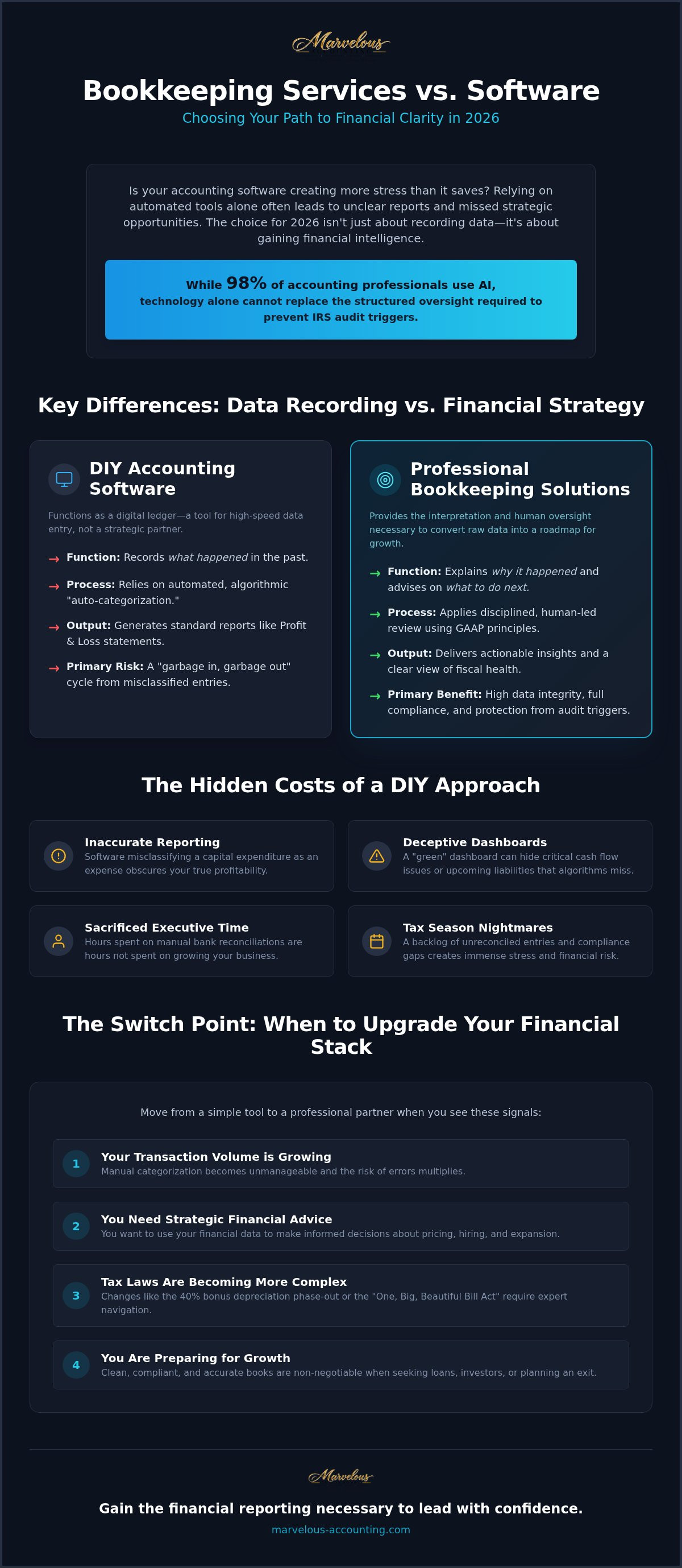
The financial landscape for 2026 has shifted from simple record-keeping to a requirement for high-level financial intelligence. Many business owners view accounting software as a complete solution, but it functions primarily as a digital ledger. It records what happened; it doesn't explain why it happened or what should happen next. This distinction is the core of the bookkeeping services vs software debate. Software is a tool for data entry, while Bookkeeping Solutions provide the interpretation and oversight necessary to drive growth. You're not just looking for a place to store receipts. You're looking for a system that provides a clear view of your cash flow and liabilities.
Relying on a "set it and forget it" approach in 2026 is a significant risk. Automated systems lack the context of your specific business goals and the nuance of changing tax laws. You don't just need a list of transactions. You need a structured framework that turns those transactions into a roadmap for your company's fiscal health. Without human intervention, software often creates a backlog of unreconciled entries that become a nightmare during tax season. Moving from data entry to financial intelligence requires a transition from passive tools to active management.
The Role of Accounting Software Solutions
Software excels at high-speed tasks. It automates bank feeds and provides standard reports like profit and loss statements. However, the limitations of algorithmic "auto-categorization" are becoming more apparent. AI might see a transaction and guess its purpose, but it can't understand the strategic intent behind a complex purchase. If your software misclassifies a capital expenditure as a simple expense, your financial reporting becomes unreliable. This creates a "garbage in, garbage out" cycle that obscures your true profitability. Modern software is a powerful engine, but it still requires a skilled operator to steer it toward accuracy.
The Role of Professional Bookkeeping Solutions
Professional services offer the human oversight that software lacks. By applying GAAP principles, experts ensure your data integrity remains high. This isn't just about moving numbers; it's about strategic oversight. Professional Bookkeeping Solutions involve a disciplined review of every ledger entry to ensure small business financial compliance. This expert layer protects you from audit triggers and ensures that your tax preparation is based on a solid foundation. You gain a partner who brings order to complex systems. This specialized care ensures that your reports are not just accurate, but also actionable for long-term planning.
Key Differences: Data Recording vs. Financial Strategy
Software focuses on the input of data. Professional services focus on the output of strategy. This distinction is vital when evaluating bookkeeping services vs software for your business. While a software platform accurately logs every transaction, it cannot tell you if those transactions align with your long-term goals. Professional oversight transforms raw data into a narrative that guides your growth. For scaling LLCs, human-led financial reporting provides a level of clarity that an automated system simply cannot replicate.
The 2026 tax year brings specific challenges, particularly with the implementation of the "One, Big, Beautiful Bill Act" passed in 2025. This legislation significantly complicates DIY filing by introducing new layers of reporting requirements that most software updates haven't fully mastered. Relying solely on automated rules can lead to non-compliance. Professional services act as a vital buffer against IRS audit triggers by ensuring every entry meets these updated standards. If you're managing complex operations, you need a steady hand to keep your systems orderly.
Beyond the Dashboard: Data Interpretation
A "green" dashboard in your software can be deceptive. It might show a positive balance while hiding critical cash flow issues or upcoming liabilities. Professional analysis identifies trends that software algorithms frequently miss, such as seasonal shifts in vendor costs or diminishing margins on specific services. Choosing outsourced accounting allows you to move beyond basic tracking and into strategic decision-making. When considering key decision-making factors for your financial stack, remember that software is a recording tool, not a business advisor.
Compliance and Regulatory Accuracy
Software doesn't know tax law; it only follows programmed logic. It can't interpret how federal regulations apply to your unique business structure. Managing complex tax obligations in 2026 requires more than just checking boxes. It requires structured accounting frameworks that prioritize accuracy and regulatory protection. To ensure your business remains compliant while you focus on operations, consider how professional financial reporting can stabilize your bottom line. Experts catch the misclassified transactions and missed deductions that automated systems overlook, saving you from costly errors and potential penalties.
The Hidden Costs of DIY Bookkeeping Software
Low monthly subscription fees make automated tools appear cost-effective. However, the sticker price of a platform is rarely the total cost of ownership. When comparing bookkeeping services vs software, you must account for the financial impact of owner-operator error. Software often fails to flag missed tax deductions or subtle misclassifications that a professional eye would catch instantly. These small mistakes compound over a fiscal year. By the time tax season arrives, "cheap" software often becomes an expensive liability that requires a professional cleanup before filing.
The financial reporting you receive from a DIY setup is only as good as the data entered. If you mislabel a capital investment as a recurring expense, your profitability metrics will be skewed. This leads to poor decision-making based on faulty intelligence. Professional Bookkeeping Solutions eliminate this risk by providing a structured framework for every entry. You aren't just paying for a ledger; you're paying for the certainty that your financial foundation is solid. Relying on an algorithm to manage complex tax obligations often results in overpaying the IRS or missing out on legal incentives like the 40% bonus depreciation rate available in 2026.
The Opportunity Cost of Admin Burden
Your time has a specific dollar value. If a business owner spends ten hours a month on bank reconciliations, those are ten hours stolen from revenue-generating activities. For a scaling LLC, this administrative burden represents a significant opportunity cost. Founders should focus on executive strategy rather than data entry. The mental load of financial uncertainty is another hidden drain. When you're unsure if your books are accurate, you hesitate on major investments. Delegating these tasks to a specialist provides the mental clarity needed to lead with a steady hand.
The Cost of Audit Exposure
Common software errors frequently trigger IRS flags. Automated systems don't understand the nuance of current federal regulations, especially with the reporting changes introduced for the 2026 tax year. Messy books are a magnet for federal inquiries. Utilizing professional bookkeeping and tax services provides a critical layer of protection. A professional review ensures that your records are audit-ready at all times. The expense of "cleaning up" a year's worth of disorganized data in April is almost always higher than the cost of ongoing, structured management. Investing in expert oversight now prevents the high-stress, high-cost scramble of a future audit.
The Switch Point: When to Move from Software to Services
Every growing business reaches a ceiling where automated tools no longer suffice. For many startups, software is an adequate starting point for basic ledger entries. However, as your operations expand, the limitations of an algorithm become a bottleneck. When analyzing bookkeeping services vs software, the most critical factor is identifying the switch point. This is the moment when the complexity of your financial data outpaces the capabilities of your current tools. If you're managing multiple revenue streams or high transaction volumes, relying on software alone puts your fiscal health at risk.
The 2026 tax landscape requires a higher level of precision than previous years. The "One, Big, Beautiful Bill Act" of 2025 introduced reporting nuances that standard software often fails to capture correctly. If your business involves inventory management, multi-state sales, or a growing team of employees, your filing requirements have likely become too complex for a DIY approach. Transitioning to professional oversight ensures that you remain compliant with these evolving federal regulations while maintaining an accurate view of your bottom line.
Revenue and Complexity Markers
Reaching the $250,000 annual revenue mark is a standard transition point for most LLCs. At this level, the stakes for tax preparation and financial reporting increase significantly. Complexity markers like managing accounts payable and receivable across different states also necessitate a move toward managed solutions. If you're seeking outside investment, generic software reports won't satisfy sophisticated lenders or partners. You need GAAP-compliant financial statements that only professional Bookkeeping Solutions can provide. This structured approach brings the order required to scale without administrative friction.
Evaluating Your Current Financial Health
Determine if your current setup is sufficient by asking three direct questions. First, do you spend more than five hours each month on manual reconciliations? Second, are you 100% confident that your books reflect your actual cash position? Third, can you use your current reports to make immediate strategic decisions? If the answer to any of these is no, your software is no longer reflecting reality. Signs of drift include unreconciled bank feeds and persistent "uncategorized" entries. To stabilize your growth and ensure total accuracy, it is time to implement professional bookkeeping solutions. Preparing for tax season early in the fiscal year prevents the high-cost scramble of year-end cleanups.
Marvelous Accounting: Structured Solutions for LLC Success
Marvelous Accounting, LLC provides the disciplined oversight that automated tools lack. We implement structured accounting frameworks designed to bring order to complex financial systems. While the bookkeeping services vs software debate often focuses on cost, the real value lies in accuracy and risk mitigation. We serve as a steady hand for national US-based small businesses, ensuring that every transaction aligns with regulatory standards. Our approach moves beyond simple data entry by integrating professional Bookkeeping Solutions with expert Tax Preparation Services to create a seamless financial infrastructure.
Year-round professional oversight is the only way to ensure your business remains audit-ready. Software updates can lag behind legislative changes, but our specialists stay current on all federal requirements. We don't just record what happened in the past; we prepare your business for the future. By maintaining a clean ledger throughout the fiscal year, we eliminate the stress and high costs associated with year-end cleanups. This proactive management allows you to lead your company with the confidence that your financial foundation is secure.
Comprehensive Financial Reporting
Our Financial Reporting services provide more than just standard profit and loss statements. We deliver actionable fiscal insights that help you identify growth opportunities and potential cash flow bottlenecks. You need to stay well-informed to make high-stakes executive decisions. Our structured reporting ensures you maintain a clear understanding of your fiscal health 365 days a year. This level of transparency allows you to see exactly where your capital is deployed and how it is performing, moving your business from reactive tracking to proactive strategy.
Expert Tax Preparation and Compliance
Managing complex tax obligations requires professional precision, especially under the evolving 2026 federal landscape. We streamline your financial record-keeping to ensure that your tax filings are accurate and fully compliant. This integration prevents the common errors that trigger IRS inquiries. To stabilize your financial infrastructure and gain the strategic support your LLC deserves, request a consultation for professional bookkeeping solutions. Our team ensures that your tax strategy is built on a foundation of integrity and expert oversight, allowing you to focus entirely on scaling your operations.
Strategic Financial Management for 2026 and Beyond
Choosing the right path for your business requires a clear understanding of your long-term goals. While software provides a digital record of your transactions, it lacks the strategic oversight necessary to navigate 2026 tax complexities. The decision between bookkeeping services vs software depends on whether you need a simple data entry tool or a comprehensive growth strategy. Moving beyond basic automation allows you to reclaim your executive time and eliminate the administrative burden that stalls scaling businesses.
Marvelous Accounting, LLC provides the structured frameworks needed to bring order to your financial systems. We offer expert Tax Preparation Services for complex obligations and comprehensive Financial Reporting to keep you well-informed. Our national US-based Bookkeeping Solutions ensure you remain compliant while gaining the fiscal insights required for confident decision-making. Don't let disorganized data hinder your progress. Secure Your Financial Infrastructure with Marvelous Accounting today. Your business deserves the stability of a steady hand and a partner committed to your success.
Frequently Asked Questions
Can I use bookkeeping software and still hire a professional service?
Yes, you can integrate both to maximize your financial accuracy. Most professional firms use software as the underlying engine while providing the expert oversight that algorithms lack. This combination ensures your data is recorded correctly and interpreted strategically. When comparing bookkeeping services vs software, remember that the service layer adds the human judgment necessary to catch errors that automated systems frequently overlook. This hybrid approach provides the most robust protection for your LLC.
How does the 2025 tax legislation change how I should use bookkeeping software?
The "One, Big, Beautiful Bill Act" passed in 2025 introduced complex reporting requirements that standard software updates often struggle to interpret. You can't rely on automated categorization alone to meet these new 2026 mandates. Professional oversight is required to ensure your digital ledger correctly reflects these legislative changes. Without human review, your software might misclassify entries that lead to non-compliance or missed deductions under the current federal tax code.
What is the average cost of professional bookkeeping solutions vs. a software subscription?
Software subscriptions typically involve a low monthly fee but carry significant indirect costs in owner-operator time and error risk. Professional Bookkeeping Solutions represent a higher direct investment but generate long-term savings by preventing costly IRS penalties and maximizing legal tax deductions. You must weigh the sticker price of a platform against the value of your executive time. Outsourcing these tasks allows you to focus on revenue-generating activities that far outweigh the service fee.
Is accounting software enough for a new LLC with few transactions?
Software is a common starting point for micro-businesses, but it doesn't establish the structured accounting frameworks required for scaling. Even a small volume of misclassified transactions in your first year can complicate future Tax Preparation Services. Starting with professional oversight ensures your financial foundation is solid from day one. This proactive approach prevents the high-cost scramble of cleaning up messy books once your transaction volume and business complexity inevitably increase.
Will a bookkeeping service help me with my 2026 tax preparation?
Yes, choosing an integrated service ensures your ledger is perfectly aligned with your filing requirements. Marvelous Accounting, LLC combines Bookkeeping Solutions with Tax Preparation Services to create a seamless transition from daily record-keeping to annual filing. This year-round oversight means your records are always audit-ready. You won't have to worry about missing deadlines or overlooking complex tax obligations because your financial infrastructure is managed by experts who understand the 2026 regulatory landscape.
How do professional services prevent IRS audits compared to software?
Professionals apply GAAP principles and human judgment to identify inconsistencies that software algorithms miss. Automated systems follow programmed rules but don't understand the strategic context of your transactions. Experts flag common audit triggers, such as unusual expense ratios or inconsistent reporting, before they reach the IRS. This disciplined review process creates a protective buffer. It ensures your Financial Reporting is accurate and compliant, which significantly reduces the likelihood of a federal inquiry.
What is the difference between financial reporting and simple bookkeeping?
Simple bookkeeping is the mechanical act of recording business transactions. Financial Reporting is the high-level interpretation of that data into actionable intelligence. While bookkeeping tells you what you spent, reporting tells you what those expenditures mean for your profitability and cash flow. You need these insights to make informed decisions about hiring, expansion, and capital investments. Professional services provide this strategic layer to help you maintain a clear understanding of your fiscal health.
Can I switch from software to a professional service in the middle of the year?
You can transition to professional management at any point in the fiscal year. A specialized firm will reconcile your previous months and clean up any disorganized data to ensure your records are accurate. This mid-year shift is often the best way to stabilize your financial infrastructure before the tax-season rush. Waiting until the end of the year only increases the complexity and cost of the necessary cleanup. Expert guidance brings immediate order to your systems.


